
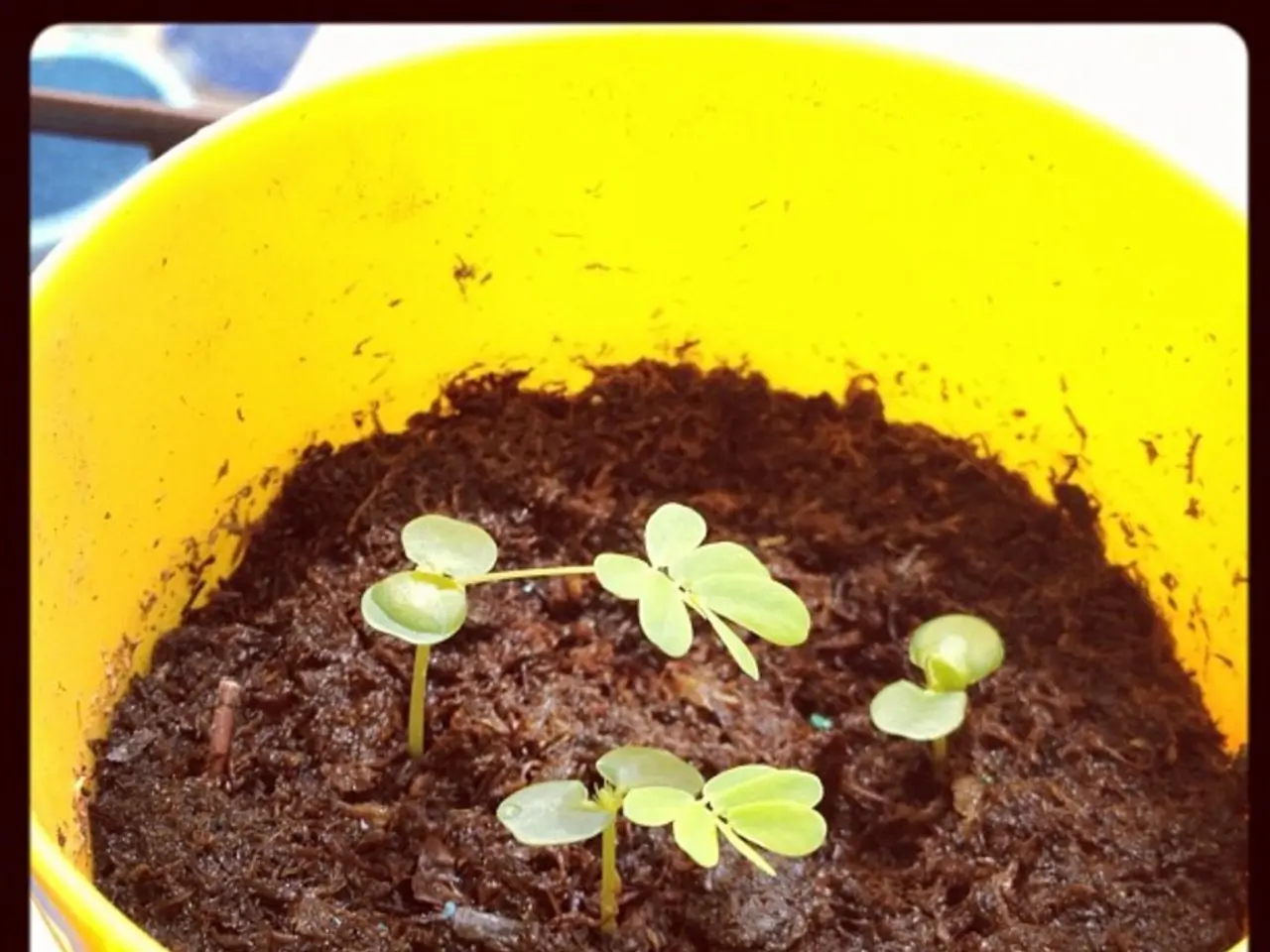
Slow-Release Fertilizers Applied in Cultivating Ornamental Plants in Containers
Controlled-release fertilizers (CRFs) have revolutionised the world of horticulture, offering a solution to the problem of nutrient losses and pollution potential. These fertilizers, encapsulated in a coat that slowly releases nutrients over time, are a type of slow-release fertilizer (SRF).
The rate of nutrient release from CRFs in the root zone is influenced by several key factors. The coating material properties, such as the type, thickness, and composition, control how water penetrates and dissolves the nutrients inside, thereby regulating the release rate. Coating physical characteristics, like water contact angle, porosity, and cross-linking density, also impact nutrient release duration and rate.
Soil moisture availability is critical, as water movement into the coated granules initiates nutrient dissolution and release. Higher soil temperatures generally increase the rate at which coatings allow nutrient release due to faster diffusion and chemical processes inside the coating.
Application method and location also play a significant role. Incorporation into the growing medium versus surface top dressing affects nutrient availability dynamics and microbial activity around the root zone. Crop-specific nutrient demand and growth stage can also influence release dynamics, with some CRFs being tailored to align nutrient release patterns with crop requirements.
Microbial activity, while less significant compared to other SRFs, can still influence nutrient availability indirectly by affecting soil conditions. Environmental factors, such as soil pH, moisture retention, and interaction with soil components, can also affect nutrient release and availability.
In the greenhouse and nursery production systems, which require high amounts of fertilizer for appropriate growth, CRFs can be applied to container-grown plants in various ways, including top-dresses, dibble planting, incorporation into the media, and layering. For small containers, it is recommended to use CRFs with smaller diameter prills for uniform distribution, or to apply both CRFs and water-soluble fertilizers.
The most common CRF longevities are 3-4 months, 5-6 months, 8-9 months, and 12-14 months. However, higher application rates are required for CRFs with extended longevities to meet the demands of rapidly growing crops. At low application rates, longer longevity CRFs may not provide enough nutrients for rapidly growing crops, necessitating adjustments to the application rates for optimal plant growth.
When using CRFs, it is crucial to avoid over-irrigation to prevent nutrient leaching and to follow the label directions for the specific fertilizer being used. Research has shown that CRFs cause less substrate pH drift than water-soluble fertilizers, requiring adjustments to the amount of acid added to compensate for high alkalinity levels in the irrigation water.
In conclusion, nutrient release from controlled-release fertilizers is primarily governed by the physical and chemical characteristics of the coating material and environmental conditions such as moisture and temperature in the root zone, with additional influences from application methods and crop-specific customization. By understanding these factors, growers can make informed decisions about the use of CRFs in their horticultural practices.
- To optimize the health-and-wellness of crops and ensure proper nutrition, growers must consider crop-specific nutrient demand and growth stage when applying controlled-release fertilizers (CRFs), aligning nutrient release patterns with crop requirements.
- In the realm of horticulture and nutritious food production, horticulture scientists are increasingly pursuing research in the field of nutrition, seeking to develop CRFs with longer release durations that can cater to the increased nutrient demand of rapidly growing crops.